Showing posts with label rescue. Show all posts
Showing posts with label rescue. Show all posts
Wednesday, 14 October 2015
How many firefighters should be on a fire engine
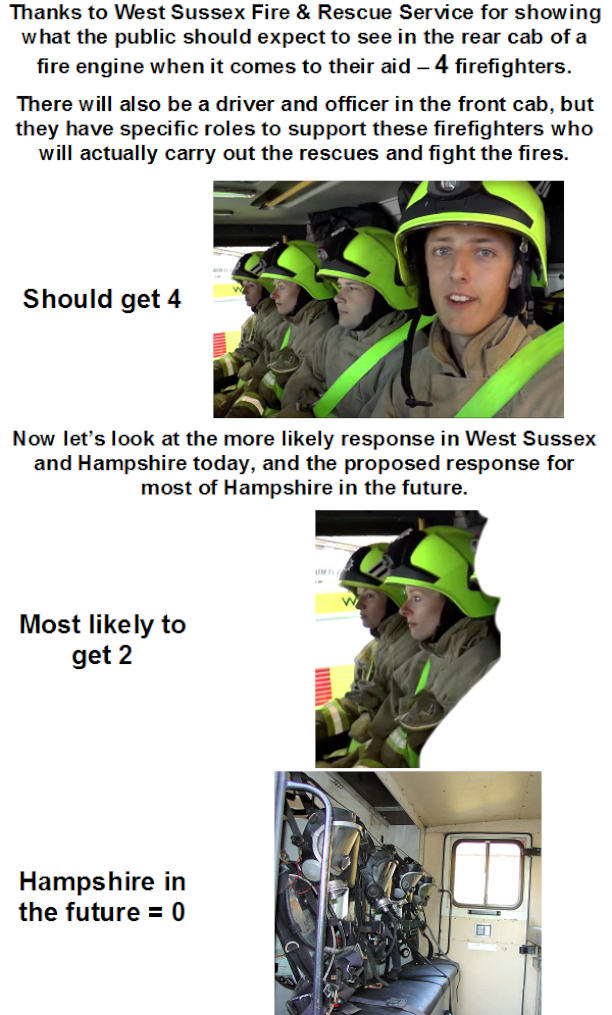
West Sussex Fire & Rescue Service has just launched a much needed recruitment campaign for Retained (Part time) Firefighters with an excellent video. In it they show exactly how many firefighters should be in the rear cab of a fully crewed fire engine. Sadly that does not reflect today's reality, and it certainly does not reflect Hampshire Fire Authority's proposed cuts, which will also affect parts of West Sussex.

Monday, 7 September 2015
Cuts Will Cost Lives

This is what Councillors seem oblivious to and senior officers seem to have forgotten about.
This rescue in Suffolk at the weekend involved two ladders, at least six firefighters engaged in the rescue and at least eleven firefighters at the incident when the rescue was carried out.
Crews of four don't cut it and Hampshire's proposed crews of two in a van are a sick joke.
Incidents like this don't happen every day, but no one knows where or when they will happen.
There is absolutely no doubt, cutting resources will cost lives. Well done to the firefighters involved.
There is absolutely no doubt, cutting resources will cost lives. Well done to the firefighters involved.
If further confirmation that cuts cost lives is required, just read this:

Saturday, 9 May 2015
Gatwick Airport and the Local Authority Fire Service - Some Facts
The discussion on how West Sussex County Council cuts to the
fire and rescue service have affected the response to emergencies at Gatwick
Airport has thrown up some worrying misconceptions. Not least from County
Councillors and, apparently, some fire service officers. This seems to revolve around unrealistic
expectations of the airport’s fire and rescue service. Irresponsibly there are
those that claim they can deal with any major incident on their own, so let’s
look at the facts.
The requirement on the airport operator comes from the Civil
Aviation Authority’s ‘CAP 168’, Licensing of Aerodromes, which is based on the International Civil Aviation Organization’s agreed
guidance. That says the airport fire service is provided to, “create and
maintain survivable conditions, to provide egress routes for occupants and to
initiate the rescue of those occupants unable to make their escape without
direct aid.”
You will note that for rescue it only requires them to “initiate”
rescue. They go on to say that “the saving of those occupants unable to make
their escape without direct aid may be a long and arduous task”. They also make
clear that on occasions this will involve the use of specialized equipment and
personnel not part of the airport fire service. Something that was well
illustrated by the Kegworth crash that required over 100 local authority
firefighters and 22 fire engines.
That is why there are several references in CAP 168 to “Local
Authority Fire Services”. The CAA does not require airports to provide
resources to fully deal with crashes, just to provide the immediate response. It
even reminds airport operators that, “At all incidents it should be remembered
that the Local Authority Fire Service has statutory obligations to fulfil.”
Something that West Sussex County Council has tried to ignore.
The emphasis in CAP 168 is on an airport fire service that
can arrive quickly and extinguish any fire that results from a crash. The
number of vehicles and personnel required are determined by that objective. In
some cases that will be sufficient to allow all survivors to escape unaided,
but where there is significant damage, then rapid reinforcement of the airport
fire service will be essential.
There is no requirement for the airport to have the sort of
heavy duty rescue equipment that is carried on the West Sussex Heavy Rescue
Tenders (HRT). That is why the failure to ensure that Crawley’s HRT attends warnings
of aircraft in trouble is so worrying. Made worse by the fact that, when an
alert is received, all the personnel from Crawley are sent on their standard
fire engines, which leaves the HRT with no crew. So, if there is a crash,
another HRT will have to travel at least 35 miles to the airport.
It also needs to be remembered that there is a busy railway
line at the end of the runway. The potential for an aircraft to hit one or more
commuter trains is ever present. There could be many hundreds of casualties as
a result, yet WSCC’s cuts culture is deemed more important than the survival of
passengers and crew in a crash at Gatwick. The reduction in the response to the
most serious warning, “Aircraft Accident Imminent”, from 10 to just 6 fire
engines is wholly unjustified.
Gatwick Airport, for the most part, meet their obligations
under CAP 168. The main concern is that they may not have adjusted their
emergency plan to take account of both the cuts and WSCC’s dreadful failure to
properly crew their remaining fire engines. With part time crewed fire engines
often being unavailable, resources will have to travel much further and take
far too long to arrive.
The removal of the HRT and other special vehicles from the
response to alerts that aircraft are in trouble flies in the face of proper
risk assessment. West Sussex send an Aerial Ladder Platform from Horsham or
Worthing to warnings of aircraft in trouble, just in case the aircraft is an
A380. That is fair enough, but to not send the HRT that would be essential for
a serious crash involving any aircraft suggests a total lack of logic when
carrying out risk assessments, or a complete lack of understanding of aircraft crashes.
A Gatwick Airport spokesperson is reported to have said, "Gatwick
has its own on-airport fire service that is fully equipped and resourced to
deal with major incidents." A spokesperson who clearly has no idea of CAP
168, of the potential scale of an aircraft crash, or of the level of resources at the
airport. No doubt WSCC will also soon provide false, unsubstantiated
reassurance to the public with yet more ‘spin’.
Saturday, 2 May 2015
COUNCIL RISK PASSENGER LIVES AT GATWICK AIRPORT
Press Release circulated yesterday:


The West Sussex Fire & Rescue Stop the Cuts group
is concerned that survival chances for passengers and crew, in the event of a
crash at Gatwick Airport, have been seriously reduced by County Council cuts to
the fire service. A spokesperson said, “Not only have the cuts put 800,000
residents in greater danger, but millions of passengers who use the airport each
year will be doubly unlucky if they are in a crash at Gatwick”.
The spokesperson continued, “We all hope we are not involved
in an aircraft crash, but there are several around the World every year. When it
happens we rely on the emergency services arriving quickly to rescue survivors
from the wreckage. Sadly the response from West Sussex Fire & Rescue
Service is now slower and smaller than ever, despite aircraft now carrying more
people”.
The spokesperson added, “The airport is not responsible, as
they have an effective fire service, but for crashes they need significant support
from local emergency services. The only criticism of the airport is that,
according to the County Council, they raised no objections to the cuts[1]”.
Retired Fire Service Operational Planning Officer Tony
Morris said, “Not only do the cuts affect survival chances at the airport, but
if a plane comes down beyond their very small response area, the airport’s fire
service does not respond. Survivors would then be totally reliant on the hopelessly
inadequate local fire service response. Firefighters would do their best, but
the odds would be stacked against them”
West Sussex County Council cuts include:
- The two nearest fire engines to the airport could reach the airport in two minutes, but they were removed in the last round of cuts.
- The next nearest fire engines at Crawley have just been cut from three to two.
- Response to the most serious category of emergency has been cut from ten fire engines to just six, despite aircraft now carrying more passengers. Other essential specialist vehicles have also been removed from the automatic response.
- Together with cuts in crew numbers, instead of around 90 firefighters being sent, less than 50 will arrive. Yet they know that at the Kegworth crash in 1989, over 100 hundred firefighters were needed to rescue the 82 injured survivors.
- The Heavy Rescue Tender, with specialist rescue equipment, is no longer sent when emergencies are declared. Gatwick is now the only international airport in Europe not to get a specialist rescue vehicle from their local fire service when aircraft are in trouble.
- Even worse, when an emergency is declared the two fire engines from Crawley are sent, but no firefighters are left to crew the Heavy Rescue Tender. If a crash then occurs another vehicle will have to be sent from 35 miles away.
- Whilst they have stopped sending this rescue vehicle, they do send a high reach aerial appliance, just in case the aircraft is a large Airbus A380. To do that, but not send the rescue vehicle, which would be essential at any crash, makes no sense and indicates that professional judgement is either flawed, or cuts are forcing these dangerous changes.
- Foam supplies have been removed from the nearest station to the airport and now have to be sent from 50 miles away. Last time these were sent to an emergency at the airport they took over an hour and a quarter to arrive.
- Inadequate crewing across West Sussex also means that many of the nearest fire engines and support vehicles are often unavailable. As many as 16 of the nearest 22 fire engines have been without crews on occasions, and response times have increased dramatically.
- At a recent incident in Crawley, cuts and inadequate crew levels showed that the nearest ten fire engines included two from Brighton, nearly 30 miles away. With Gatwick located in the Borough this is a disgraceful level of protection.
Mr Morris concluded, “When early warning is received of an
aircraft in serious trouble at Gatwick, the public expect the local fire
service to be there with enough resources to give them a good chance of
survival. It is shameful that West Sussex County Councillors are failing to
ensure that happens.”
West Sussex Fire
& Rescue Stop the Cuts
ENDS
Further
information
Email: wsfrsstopcuts@aol.com
Facebook: West Sussex Fire & Rescue Stop the Cuts
NOTES
1. At all the other airports in the UK that handle the Airbus
A380 aircraft, the airport authorities have equipped their own fire service
with an aerial appliance. Gatwick rely on the local fire service to send one
from Horsham (16 miles away), or from Worthing (35 miles away).
2. The Kegworth Comparison – this crash in 1989 involved 118
passengers, 82 of whom were seriously injured. Their rescue required the
airport fire service plus 22 fire engines and over 100 firefighters from local
fire services.
The latest aircraft using Gatwick include the Airbus A380,
versions of which carry over 550 passengers. Instead of increasing the response
to cope with the greater challenge, West Sussex Fire & Rescue Service has
quite unprofessionally reduced it to the lowest it has been since the 1950s.
3. Tony Morris
responded to the Airports Commission consultation to highlight these problems.
A copy of his submission is attached below (Annex 1).
Annex 1
|
From
|
Tony Morris tonyacmorris@aol.com
|
|
To
|
airports.consultation airports.consultation@systra.com
|
Important factor omitted from review of possible second
runway at Gatwick Airport
Dear Mr Davies,
I am writing to you as an individual. I am now retired, but
was an Emergency Planning Officer for West Sussex County Council (1999 to 2014)
and before that the Operational Planning Officer for West Sussex Fire
& Rescue Service (1993 to 1999). In both posts I worked closely with other
emergency services and the airport operator on planning for all types of major
emergency at Gatwick.
There appears to have been an important omission in the
debate regarding a possible second runway at Gatwick Airport. That omission
concerns consideration of the ability of hospitals, the emergency services,
local authorities etc. to cope with an aircraft accident, or other major
incident at the Airport.
I believe this aspect is even more vital than the
infrastructure to support the airport. It is becoming increasingly clear that
these services are less well able to respond to an incident at Gatwick than
previously, primarily as a result of budget cuts. Whilst I am less familiar
with their ability at Heathrow, I believe they have significantly more resources
close to the airport. In addition, whereas West Sussex Fire & Rescue
Service (WSFRS) has removed the two nearest fire engines to Gatwick and intend
to remove the third nearest, London Fire Brigade has increased resources in the
vicinity of Heathrow. The attached maps illustrate the disparity between the
airports with regard to the location of supporting fire stations.
It is quite clear that the ambulance service and hospitals
in Sussex are struggling to cope with winter pressures, so their potential to
also cope with hundreds of casualties from an air crash must be in serious
doubt. Sussex Police have also suffered staffing cuts that affect their ability
to deal with major emergencies. The ability of West Sussex County Council's
Social Care department to provide support to uninjured survivors and relatives
of the injured or deceased is another vital service that has been affected by
budget cuts.
The latest aircraft using Gatwick include the Airbus A380,
versions of which carry over 550 passengers. When you consider that the
aircraft involved in the Kegworth air crash in 1989 was only carrying 118
passengers, you get an idea of the significantly greater demand on local
services if a larger aircraft crashes at Gatwick. At Kegworth 82 people were seriously
injured and it took over seven hours to free them all from the wreckage. The
local authority fire service needed 22 fire engines and over 100 firefighters
at the incident.
It should also be borne in mind that the Civil Aviation
Authority say that planning should consider more than one aircraft being
involved in an accident, and the surroundings of the Airport should also be
taken in to account. With a busy commuter line at the end of the runway, an
aircraft collision with a crowded commuter train must also be considered.
Casualties could run in to the thousands at Gatwick.
West Sussex Fire & Rescue Service's cuts and crewing
difficulties have made the fire and rescue service much less able to cope than
in previous years. The well publicised emergency landing at Gatwick Airport at
the end of December showed that, instead of resources increasing to cope with
increased risk, they have actually been reduced. The time taken to get
resources to the airport has increased significantly, as they have to be sent
from stations much further away. The proposed 2015-16 cuts will make this even
worse.
When aircraft carried fewer passengers, WSFRS were able to
get the full response to the airport by sending fire engines from fire stations
that were within 13 miles of the airport. At the 29th December 2014 incident,
despite having reduced the scale of the response, it had to come from fire
stations up to 40 miles from the Airport. A special vehicle carrying foam, that
used to be at the nearest fire station to the airport, took an hour and a
quarter to arrive in December. A specialist rescue vehicle is no longer sent
automatically, because of crewing shortages. If an aircraft does
crash, then that rescue vehicle will have to be sent from at least 30
miles away. With the potential for several hundred trapped and
injured casualties, that is just not acceptable.
Please note that the Airport Fire Service depend heavily on
support from WSFRS. The Airport Fire Service is only required to provide a
full response to crashed aircraft within the airport boundary, and a reduced
response to crashed aircraft very near to the airport. Beyond that small area,
the survival of casualties is wholly dependent on an increasingly under
resourced local authority fire and rescue service.
This situation is unacceptable for one runway, but I
appreciate that is beyond your control. However, recommending a second runway
at Gatwick would increase capacity and the likelihood of an accident. To do so,
whilst aware of the poor state of the local services to respond, would seem
most unwise.
I would urge you to properly consider this aspect before
deciding on your recommendation regarding Airport expansion.
Yours sincerely,
Tony Morris
Proximity of fire stations
Heathrow
Gatwick
Please note that Surrey Fire
& Rescue Service are building a fire station at Salfords, for one fire
engine, about five miles from the Airport.
[1] Report by Executive Director
Communities, Public Protection and Chief Fire Officer – “The Service has met with the Gatwick Airport Fire
Service Manager, who raised no objections to the proposals".
Subscribe to:
Posts (Atom)